26
+
YEAR
CO-NELE Has Obtained More Than 80 National Technology Patents & More Than10,000
Mixers.
Close search
As lithium-ion batteries continue to evolve toward higher energy density, faster charging, longer cycle life, and lower manufacturing costs, the preparation of electrode materials has become increasingly important.
Among the many steps in battery manufacturing, material mixing is a critical process that directly influences the homogeneity, dispersion, structure, and processability of electrode materials.
For this reason, intensive mixing technology is gaining attention in the preparation of lithium-ion battery materials, including cathode and anode compounds, conductive additives, binders, electrode slurries, and structured dry electrode mixes.
Why Is Mixing Important in Lithium-Ion Battery Manufacturing?
A typical lithium-ion electrode contains several functional components.
Depending on the electrode chemistry and manufacturing route, these may include:
* Active electrode materials
* Conductive additives
* Binders
* Solvents or liquid media
* Functional additives
* Other processing agents
Simply combining these materials is not enough.
The objective of electrode material mixing is to achieve a uniform and stable distribution of each component throughout the mixture while controlling agglomeration, moisture, temperature, viscosity, and other process parameters.
Poor mixing can result in uneven material distribution, conductive additive agglomeration, inconsistent electrode properties, and difficulties during subsequent coating or forming processes.
Therefore, the mixer is not simply a machine for combining raw materials. It is an important part of the electrode preparation process.
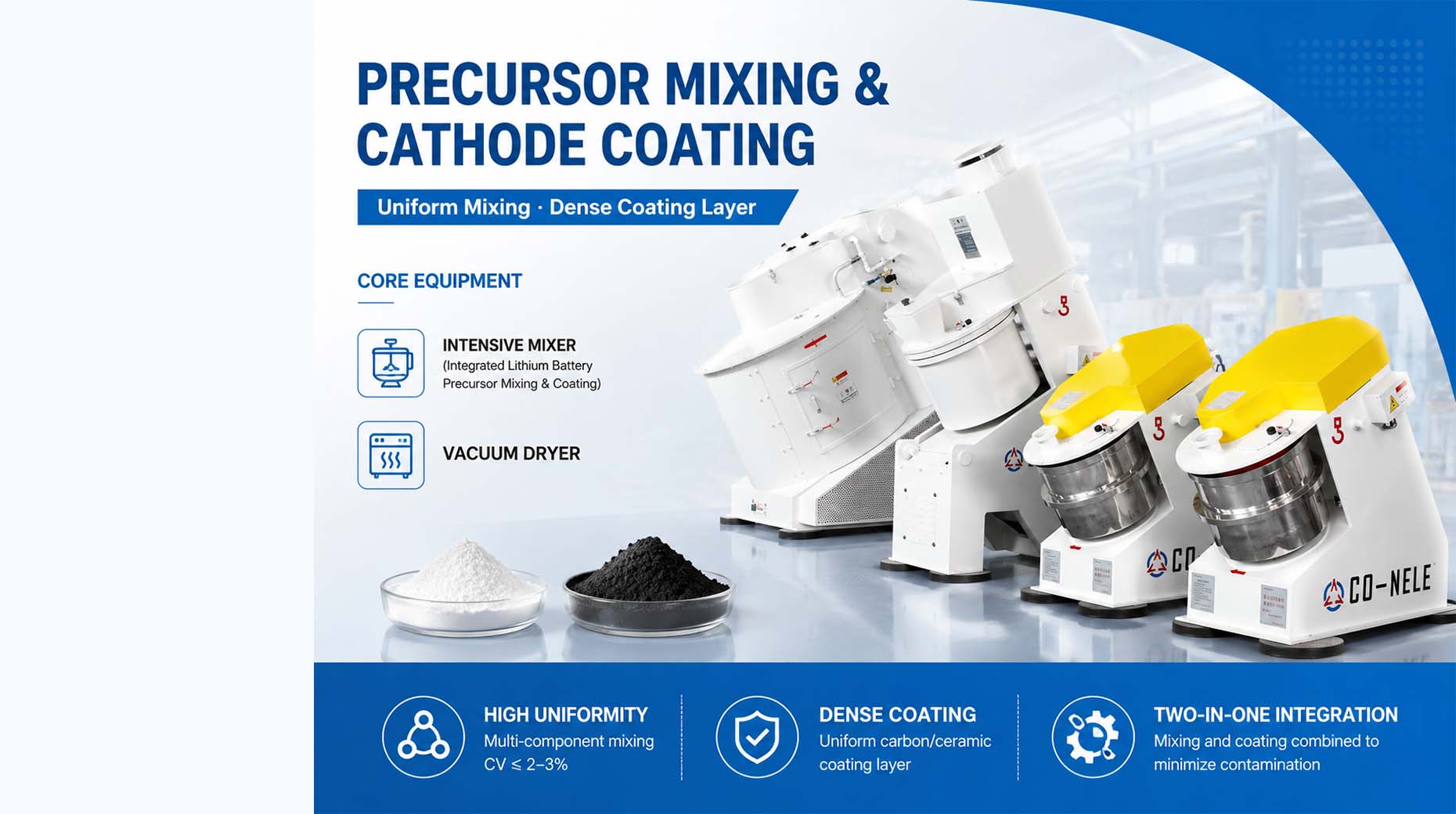
Lithium-Ion Battery Material Mixing: Why Intensive Mixers Matter in Electrode Manufacturing
What Is an Intensive Mixer?
An intensive mixer is designed to introduce a relatively high level of mechanical energy into the material being processed.
Compared with conventional low-intensity mixing, intensive mixing can provide stronger material movement, dispersion, deagglomeration, kneading, and homogenization within a relatively short processing time.
Depending on the mixer design and process requirements, intensive mixing can be applied to different material states, including:
* Dry powders
* Powder-additive mixtures
* Granulated materials
* Plastic compounds
* High-solids mixtures
* Pastes
* Electrode slurries
This flexibility makes intensive mixers particularly interesting for advanced material preparation, including lithium-ion battery electrode manufacturing.
Intensive Mixing for Lithium-Ion Battery Electrode Materials
Lithium-ion battery materials can require significantly different mixing conditions depending on the chemistry and electrode manufacturing process.
For example, cathode and anode materials may need to undergo different preparation sequences.
A simplified process can be represented as:
Raw Materials → Dry Mixing → Homogenization → Dispersion / Kneading → Liquid Addition → Slurry or Structured Dry Mix → Electrode Manufacturing
Not every battery production line uses the same process. Wet-electrode and dry-electrode technologies can require different equipment configurations and process conditions.
This is why a modern battery material mixer should be adaptable to the specific material and process rather than relying on a single fixed mixing mode.
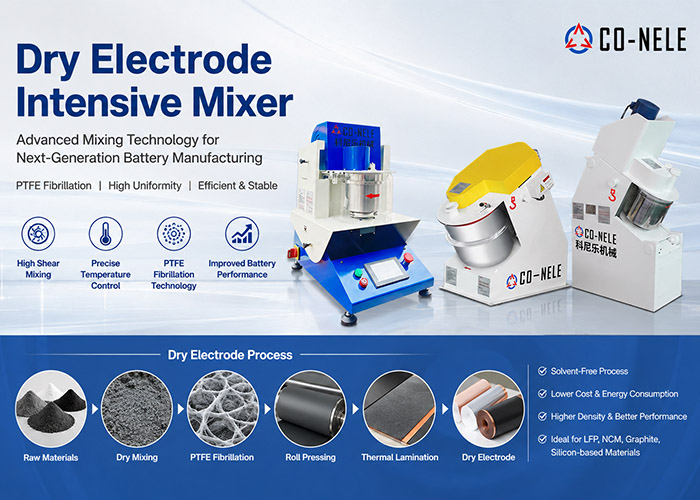
Dry electrode intensive mixer
Dry Mixing of Battery Materials
Dry mixing is becoming increasingly important as battery manufacturers investigate manufacturing processes that reduce or eliminate solvent use.
In dry electrode preparation, active materials, conductive additives, and dry binders must be distributed effectively while maintaining the required material structure.
One of the challenges is the tendency of fine powders and conductive additives to form agglomerates.
An intensive mixer can provide controlled mechanical energy to promote:
* Powder homogenization
* Agglomerate breakdown
* Conductive additive distribution
* Binder distribution
* Material functionalization
* Structured dry mix preparation
The exact mixing conditions depend on material characteristics, formulation, binder system, and the desired electrode structure.
For this reason, mixing energy, tool configuration, residence time, temperature, and material loading should be evaluated together rather than considering mixing speed alone.
Dispersion of Conductive Additives
Conductive additives play an important role in forming an electrically conductive network within an electrode.
Carbon-based conductive materials, for example, have a tendency to form agglomerates because of their fine particle size and surface characteristics.
Effective mixing should therefore promote a more uniform distribution of conductive additives throughout the active material.
The objective is not simply to break every agglomerate mechanically. It is to achieve the required dispersion while avoiding unnecessary energy input that could negatively affect the material or increase production costs.
This makes controlled intensive mixing particularly relevant to advanced electrode material preparation.
Mixing, Kneading and Dispersion
One of the advantages of intensive mixing technology is that different mechanical actions can be combined within one processing system.
Depending on the formulation and mixer configuration, the process may involve:
Mixing
Uniform distribution of different raw materials.
Deagglomeration
Reduction of undesirable agglomerates in fine powders and additives.
Dispersion
Distribution of fine additives throughout the main material phase.
Kneading
Mechanical processing of materials with increasing cohesion or viscosity.
Granulation
Controlled agglomeration when a defined granular structure is required.
Coating or functionalization
Modification of particle surfaces or distribution of functional components.
These processes can be especially relevant when battery materials move from simple powder blending toward more complex functional material preparation.
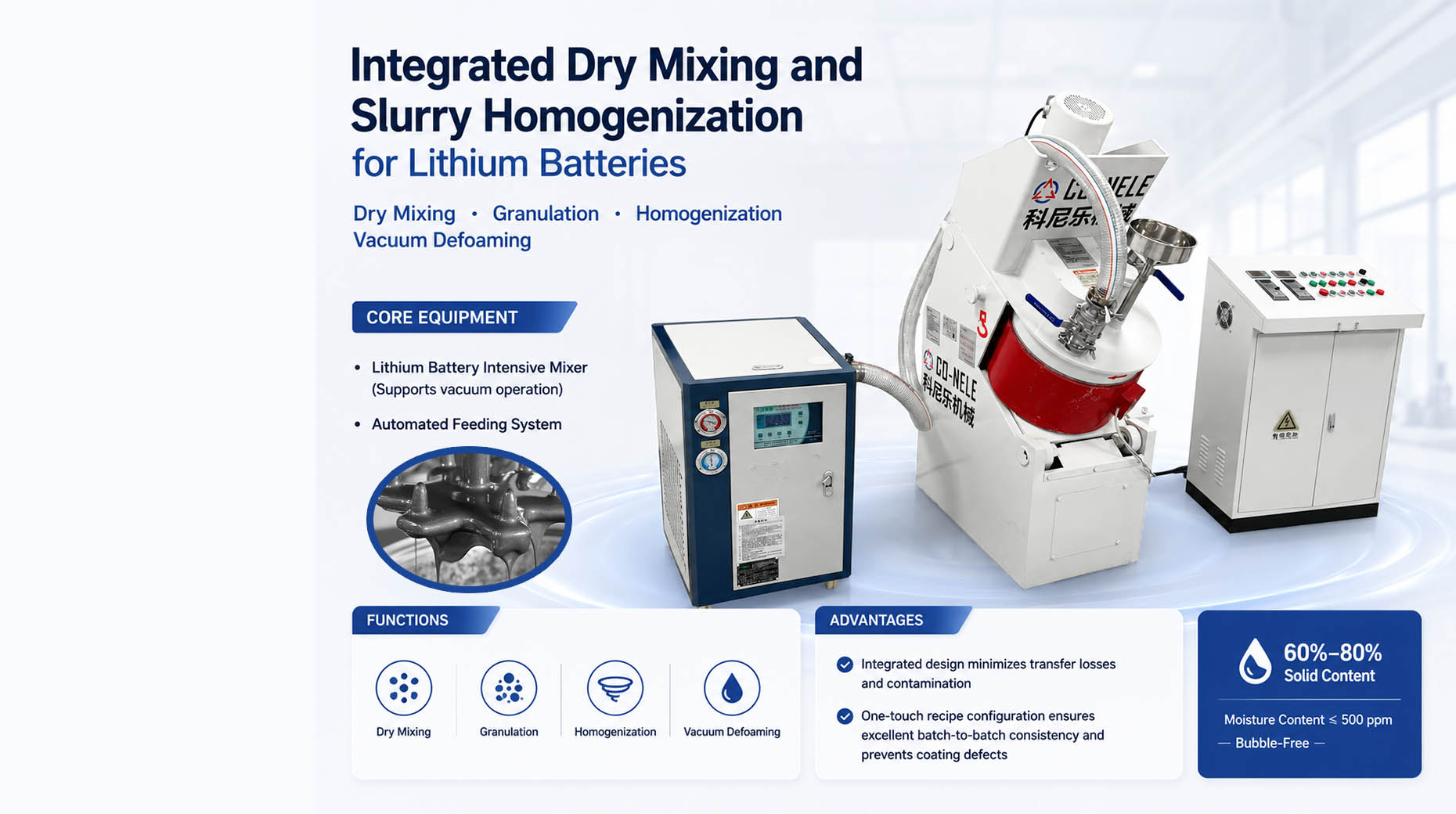
Integrated dry mixing and slurry homogenization
Wet Electrode Slurry Preparation
For conventional wet-electrode manufacturing, active materials, conductive additives, binders, and solvents are processed into an electrode slurry.
The mixing process needs to provide sufficient homogenization and dispersion while maintaining appropriate viscosity and temperature.
Depending on the formulation, the process may involve several stages:
Dry powder preparation → Binder incorporation → Liquid addition → Dispersion → Homogenization → Slurry preparation → Coating
High-solids or highly viscous mixtures can present additional challenges because material flow becomes more difficult as viscosity increases.
Therefore, mixer design, mixing tool geometry, energy input, temperature control, and process sequence all need to be considered when selecting equipment for electrode slurry preparation.
Why Process Control Matters
Battery material mixing is not simply a question of choosing a mixer with a high motor power.
A suitable mixing process should consider:
* Material properties
* Particle size distribution
* Powder flowability
* Moisture sensitivity
* Binder characteristics
* Conductive additive loading
* Solids content
* Target viscosity
* Mixing temperature
* Mixing time
* Required energy input
* Batch size or production capacity
For production applications, repeatability is equally important.
A successful battery material mixing process should deliver a consistent result from batch to batch while maintaining stable operating conditions.
CO-NELE Intensive Mixers for Advanced Battery Material Processing
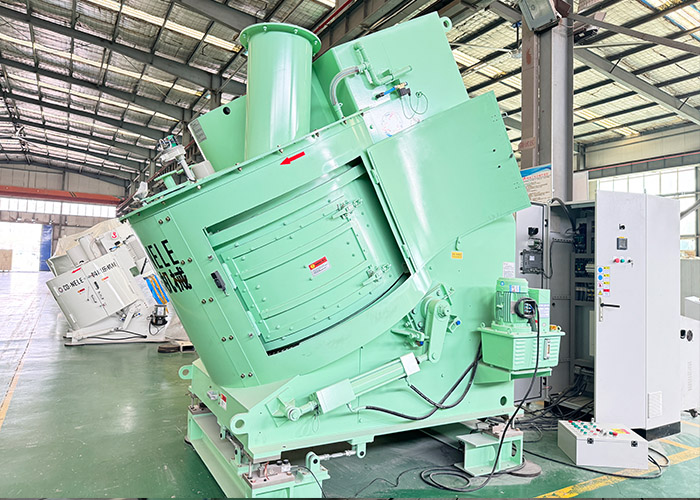
CO-NELE has developed intensive mixing technology for demanding material preparation applications across ceramics, refractory materials, mineral materials, chemical products, environmental materials, and other advanced industrial processes.
For lithium-ion battery materials, the CO-NELE CR and CRV series intensive mixers can be considered for processes requiring intensive mixing, homogenization, dispersion, granulation, coating, or other material treatment operations.
Depending on the application, mixer configuration and process parameters can be adapted to the characteristics of the material and the required production process.
For battery material development and industrial production, important factors may include:
* Mixing intensity
* Mixing time
* Material loading
* Tool configuration
* Wear protection
* Temperature control
* Discharge method
* Batch capacity
* Process repeatability
The final equipment configuration should therefore be determined through material testing and process evaluation.
From Material Mixing to Electrode Performance
The quality of an electrode begins long before coating and cell assembly.
A well-controlled material preparation process can contribute to more consistent:
Material Distribution → Electrode Structure → Coating Behavior → Electrode Properties → Cell Manufacturing
This is why lithium-ion battery material mixing deserves to be considered as a core process rather than a simple upstream operation.
As battery technologies continue to evolve, mixing equipment also needs to support increasingly diverse processing routes, including conventional wet electrodes, high-solids formulations, and emerging dry electrode technologies.
Conclusion
Intensive mixing technology provides an important processing option for lithium-ion battery material preparation.
By combining controlled mixing, homogenization, dispersion, kneading, granulation, and other material-processing functions, intensive mixers can support different stages of advanced electrode material preparation.
For battery manufacturers and material producers, the key is not simply to select the most powerful mixer, but to develop a mixing process that matches the material properties, electrode formulation, production capacity, and downstream manufacturing requirements.
CO-NELE continues to develop intensive mixing solutions for advanced materials and industrial production processes, providing customized equipment and process evaluation for demanding mixing applications.
Frequently Asked Questions
What is an intensive mixer for lithium-ion batteries?
An intensive mixer is a high-energy material processing machine designed to achieve efficient mixing, homogenization, dispersion, kneading, granulation, or other processes required for battery material preparation.
Can intensive mixers be used for dry electrode manufacturing?
Yes. Intensive mixing technology can be used for the preparation of structured dry electrode mixes, depending on the active material, binder system, formulation, and required process conditions.
Can an intensive mixer prepare electrode slurry?
Certain intensive mixer configurations can process high-solids or paste-like materials and can be used for electrode slurry preparation. The suitable configuration depends on slurry formulation, viscosity, solids content, temperature requirements, and process conditions.
What battery materials can be processed in an intensive mixer?
Potential materials include cathode and anode active materials, conductive additives, binders, graphite-based materials, silicon-carbon materials, and other functional additives. The actual suitability should be verified through material testing.
How do I select an intensive mixer for battery materials?
Mixer selection should consider material characteristics, formulation, required mixing intensity, batch size, production capacity, temperature control, wear requirements, discharge method, and the downstream electrode manufacturing process.
Can CO-NELE provide customized battery material mixing solutions?
CO-NELE can evaluate intensive mixing applications based on the customer's material and process requirements. Laboratory or pilot testing is recommended when material behavior and process conditions need to be verified before industrial-scale equipment selection.

Phone: 0086-15253277366
Hougu Town Village, Xiazhuang Street, Chengyang District, Qingdao
Copyright © CO-NELE 2019.
We will contact you within 24 hours.