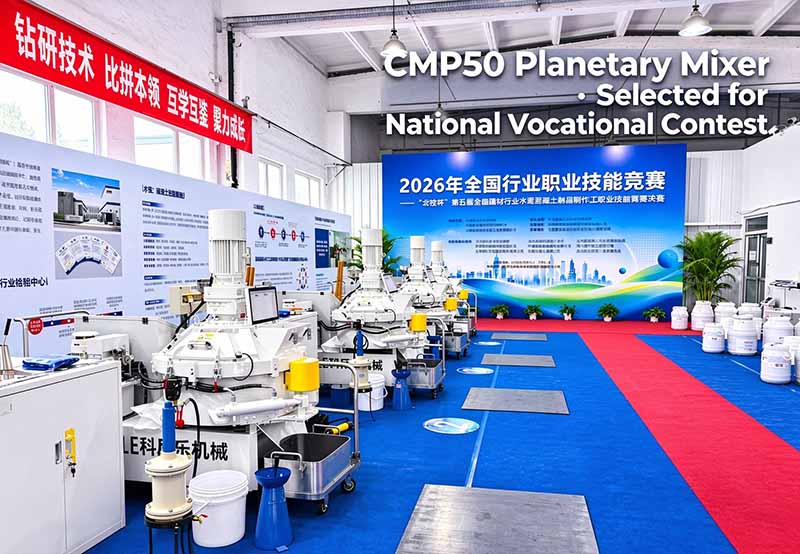
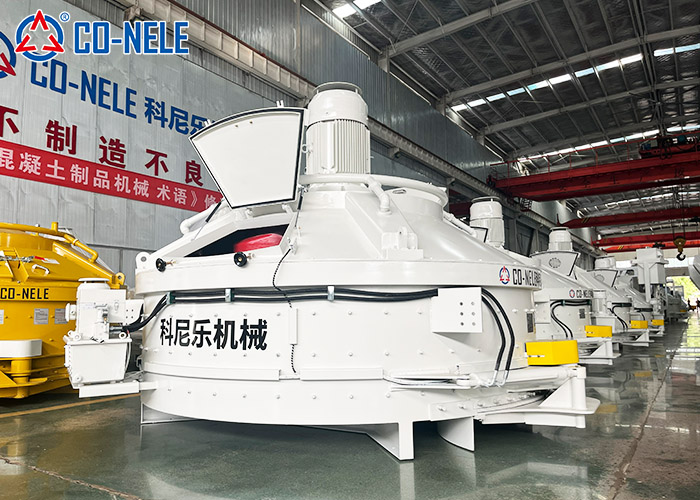
A planetary concrete mixer is a vertical shaft concrete mixing machine designed to produce homogeneous concrete through the combined rotation and revolution of its mixing blades. This compound mixing motion enables the mixing tools to cover the entire mixing pan, promoting material circulation and uniform distribution of cement, aggregates, water, pigments, and admixtures. Planetary concrete mixers are widely used in precast concrete production, concrete blocks and pavers, UHPC, SCC, GRC, and other specialty concrete applications where consistent mixing quality is essential.CO-NELE manufactures vertical shaft planetary concrete mixers, including CMP and CMPS series models, providing solutions for different batch capacities, concrete formulations, and industrial production requirements.1. What Is a Planetary Concrete Mixer?A planetary concrete mixer, also known as a vertical shaft planetary mixer, is a forced-action concrete mixing machine that uses a vertical mixing shaft and one or more planetary mixing stars.
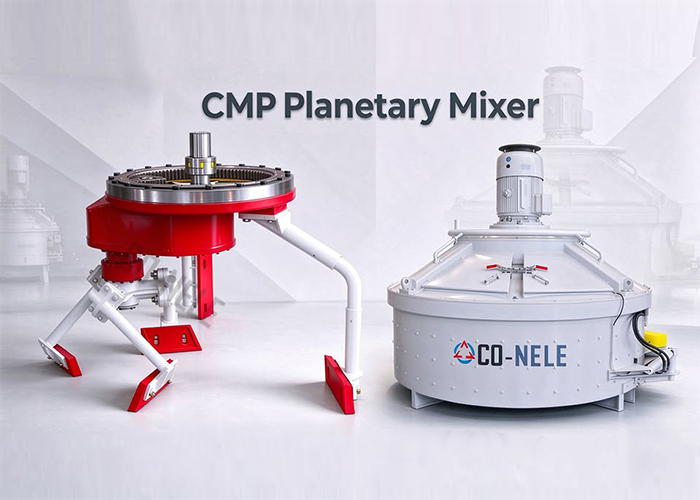
CO-NELE CMP Planetary Concrete Mixer
Unlike conventional pan mixers with fixed mixing positions, a planetary mixer combines two simultaneous movements:- Rotation: Each mixing star rotates around its own axis.- Revolution: The mixing stars move around the central axis of the mixing pan.The combination of these movements creates overlapping mixing trajectories, allowing the blades to work across different areas of the mixing chamber.This mixing principle generates three main material movement mechanisms:
| Mixing action | Function |
| Convection | Moves materials between different areas of the mixing chamber |
| Shearing | Breaks up agglomerations and promotes the distribution of fine materials |
| Diffusion | Redistributes individual particles throughout the concrete mixture |
The combined effects help improve the homogeneity of concrete mixtures, particularly those containing fine powders, pigments, fibers, and multiple aggregate sizes.2. Main Components of a Planetary Concrete MixerThe performance and service life of an industrial planetary concrete mixer depend on the design and coordination of its mechanical components.
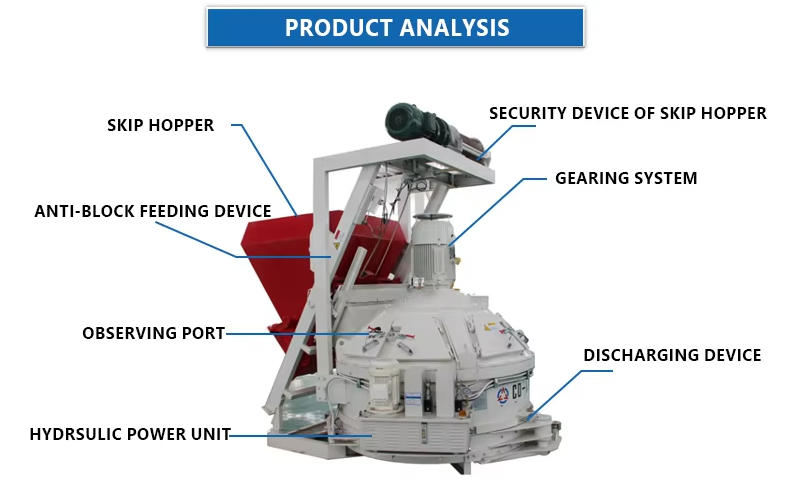
2.1 Mixing Stars and ArmsThe mixing stars are the main working assemblies of a planetary mixer. They carry the mixing arms and blades and generate the combined rotation and revolution movements.The number and arrangement of mixing stars are determined by the mixer capacity, pan diameter, and required mixing coverage.2.2 Mixing BladesMixing blades directly contact the concrete materials and generate the mechanical forces required for material circulation and homogenization.Their installation angle, shape, height, and position influence the movement of aggregates, cement paste, and fine powders.For abrasive concrete formulations, wear-resistant materials and replaceable blade designs can help reduce maintenance costs.2.3 Side and Bottom ScrapersScrapers are important for maintaining material circulation.- Side scrapers remove accumulated concrete from the inner wall of the mixing pan.- Bottom scrapers move materials from the pan floor toward the active mixing area.The clearance between the scrapers and the mixing chamber should be appropriately adjusted to balance scraping efficiency, wear, and operating resistance.2.4 Mixing Pan and Wear-Resistant LinersThe mixing pan forms the working chamber of the machine.Because concrete aggregates and mineral additives cause continuous abrasion, the inner wall and bottom are generally protected by replaceable wear-resistant liners.Depending on the application, different wear-resistant materials and liner thicknesses can be selected.
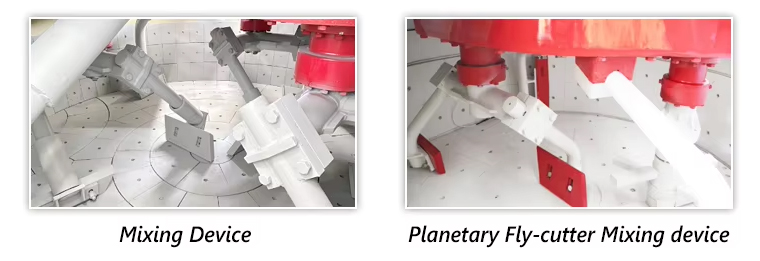
2.5 Planetary Gearbox and Drive SystemThe planetary transmission system distributes power to the mixing assemblies and maintains the required relationship between rotation and revolution.A properly designed drive system must withstand the starting torque, mixing resistance, and changing loads associated with different concrete formulations.2.6 Discharge SystemThe discharge system determines how efficiently finished concrete leaves the mixing chamber.Depending on the production requirements, planetary mixers can be equipped with different discharge gate configurations, including single or multiple discharge openings and hydraulic operating systems.The discharge arrangement should match the downstream equipment, such as concrete block machines, mould-filling systems, and transfer conveyors.3. Key Advantages of Planetary Concrete MixersPlanetary concrete mixers offer several technical advantages for concrete manufacturers who require controlled batch quality and consistent material distribution.3.1 Comprehensive Mixing CoverageThe combined rotation and revolution movements allow the mixing blades to cover different areas of the pan. This helps reduce stagnant material zones and improves mixing consistency.3.2 Uniform Distribution of Fine MaterialsThe mixing action supports the distribution of cement, silica fume, pigments, mineral fillers, and chemical additives. This is particularly important for specialty concrete formulations.3.3 Suitable for Low-Water ConcreteThe forced mixing action is suitable for dry-cast and low-slump concrete, where materials require effective mechanical movement despite relatively low moisture content.3.4 Adaptability to Specialty ConcreteWith appropriate blade configurations and mixing procedures, planetary mixers can process UHPC, SCC, fiber-reinforced concrete, GRC, and other demanding formulations.4. Applications of Planetary Concrete MixersPlanetary concrete mixers are used in a wide range of concrete manufacturing processes. Different applications require different mixing intensities, blade configurations, batch capacities, and material feeding sequences.
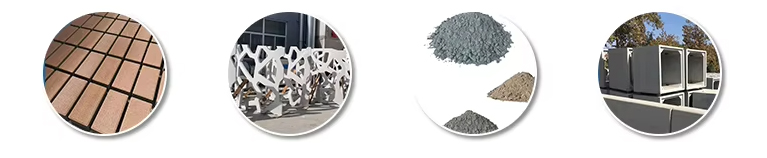
4.1 Precast Concrete ProductionPrecast concrete manufacturers use planetary mixers to prepare concrete for beams, wall panels, floor slabs, concrete pipes, utility poles, and other prefabricated components.Consistent aggregate and cement paste distribution helps maintain product density, strength, and surface quality.4.2 Concrete Blocks and Paving StonesConcrete paver production commonly requires separate mixing processes for base concrete and face-mix concrete.The base mix generally requires controlled moisture distribution and suitable compaction characteristics. The face mix requires uniform pigment distribution, fine material mixing, and consistent appearance.Planetary concrete mixers can be configured for both production requirements.4.3 UHPC and Ultra-High-Performance ConcreteUHPC typically contains cement, silica fume, quartz powder, fine aggregates, superplasticizers, and sometimes steel fibers.Its low water-binder ratio and high powder content place greater demands on mixing equipment.A properly configured planetary mixer helps distribute fine powders, form a consistent cementitious matrix, and incorporate fibers according to the required mixing sequence.Typical applications include:- Wind turbine tower segments- Bridge decks and joints- Precast bridge beams- Marine and offshore components- Architectural UHPC panels4.4 GRC and Fiber-Reinforced ConcreteGlass fiber reinforced concrete and other fiber-reinforced materials require controlled distribution of fibers within the cement-based matrix.Mixer selection should consider fiber type, fiber length, feeding sequence, mixing intensity, and the risk of fiber balling or damage.4.5 Self-Compacting Concrete (SCC)SCC requires high flowability, good segregation resistance, and consistent distribution of aggregates, cement, fillers, water, and admixtures.Planetary mixers can be used to prepare SCC for precast manufacturing and specialty concrete production.4.6 Concrete Pipes and Utility PolesConcrete pipes and utility poles often require controlled concrete consistency to meet moulding, vibration, and compaction requirements.Planetary mixing equipment can be integrated into automated batching and conveying systems for these production lines.