26
+
YEAR
CO-NELE Has Obtained More Than 80 National Technology Patents & More Than10,000
Mixers.
Close search
A high-performance GRC mixer (Glass Fiber Reinforced Concrete Mixer) is essential for achieving uniform fiber distribution, consistent mortar quality, and reliable mechanical performance in GRC components. CO-NELE planetary concrete mixers provide an efficient mixing solution for both GRC premix and spray-up production, combining planetary mixing motion, adjustable mixing speeds, and automated control to produce homogeneous cement-based mixtures while helping maintain glass fiber integrity.
From decorative GRC panels and architectural moldings to lightweight wall panels and complex precast components, selecting the right mixer can significantly influence production efficiency and final product quality.
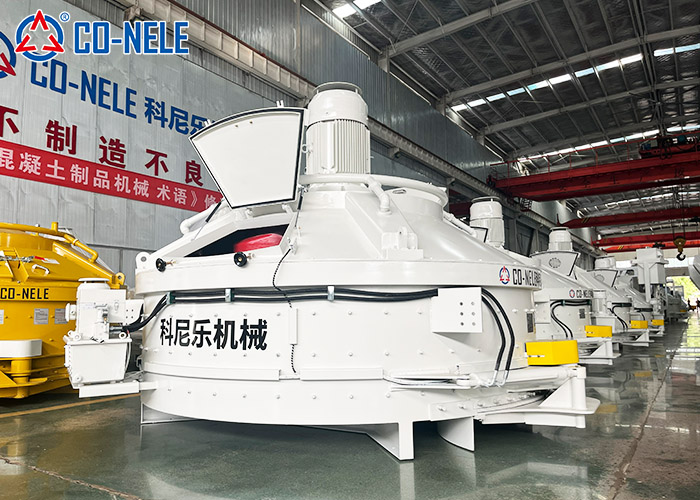
GRC mixer (Glass Fiber Reinforced Concrete Mixer)
Glass Fiber Reinforced Concrete (GRC), also known as Glass Fiber Reinforced Cement (GFRC), is a composite material made from cement, fine aggregates, water, polymers, admixtures, and alkali-resistant (AR) glass fibers.
Unlike conventional concrete, GRC relies on the uniform distribution of fine glass fibers throughout a relatively dense cement mortar matrix. Poor mixing can directly affect the strength, appearance, and durability of finished components.
Three major challenges make GRC mixing particularly demanding.
1.1 Uniform fiber dispersion
Glass fibers tend to form bundles or agglomerations if they are not properly incorporated into the mortar. Uneven distribution can result in inconsistent flexural strength, weak areas, and surface defects.
1.2 Maintaining fiber integrity
Excessive mechanical shear or unsuitable mixing conditions may shorten or damage glass fibers, reducing their reinforcing effectiveness. Mixing equipment must provide sufficient dispersion without unnecessarily aggressive mechanical action.
1.3 Handling viscous cement-based mixtures
GRC formulations often contain relatively low water-to-binder ratios, fine aggregates, polymers, and chemical admixtures. These ingredients create a cohesive, sometimes highly viscous mixture that requires effective material circulation and thorough mixing.
The challenge is therefore not simply to mix the ingredients quickly. It is to achieve three objectives simultaneously:
-Uniform distribution of cement paste, aggregates, and fibers.
- Effective dispersion with controlled mechanical action.
- Stable batch-to-batch consistency.
This is why choosing an appropriate GRC concrete mixer is an important part of GRC production line design.
A CO-NELE planetary concrete mixer uses a combination of rotation and revolution to create complex mixing trajectories throughout the mixing chamber.
As the mixing arms revolve around the central axis, the mixing blades rotate simultaneously. This compound motion continuously changes the position and direction of material movement, promoting circulation throughout the mixing chamber.
For GRC production, this design offers several practical advantages.
The planetary mixing trajectory allows the blades to cover different areas of the mixing chamber rather than repeatedly following a single circular path.
Combined with bottom and side scrapers, the system helps reduce material accumulation on the chamber walls and floor.
This promotes uniform distribution of:
- Cement and fine aggregates
- Water and liquid admixtures
- Polymer additives
- Chopped alkali-resistant glass fibers
The result is a more consistent mortar matrix for subsequent fiber incorporation and forming operations.
Glass fibers are sensitive to excessive mechanical stress. A suitable GRC mixer should therefore provide effective material circulation without relying solely on aggressive high-speed shearing.
The planetary mixing system promotes material movement through repeated blade interaction, circulation, and redistribution.
With appropriate blade configuration, mixing speed, and mixing time, it can help achieve homogeneous fiber dispersion while reducing unnecessary mechanical stress.
Actual fiber integrity depends on the fiber type, length, formulation, blade design, and operating parameters. Trial mixing is recommended when developing a new GRC formulation.
Different stages of GRC production have different mixing requirements.
For example, cement, sand, water, and admixtures need sufficient mixing intensity to form a homogeneous slurry. Glass fibers, however, require carefully controlled incorporation.
CO-NELE planetary mixers can be configured with variable-speed control to accommodate different material characteristics and mixing procedures.
A PLC-based control system can manage batching sequences, mixing duration, and operating speed.
This helps reduce variations caused by manual operation and improves repeatability between production batches.
For manufacturers producing GRC panels or architectural components in large quantities, consistent mixing conditions are particularly important.
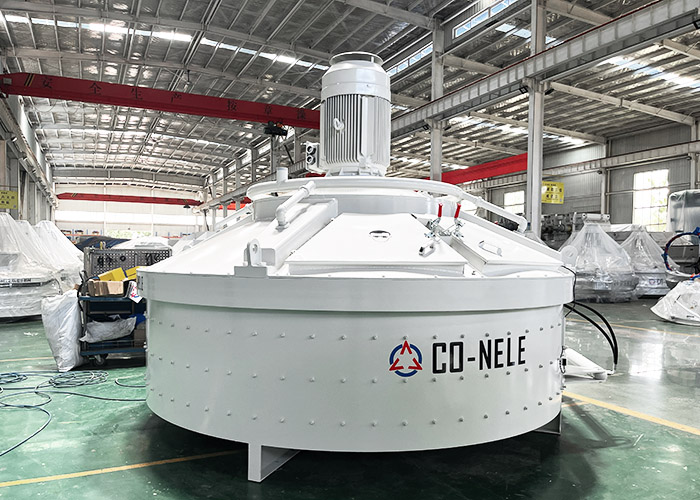
Planetary Concrete Mixer for GRC
GRC manufacturing mainly uses two processes: Premix and Spray-up. Although both require homogeneous cement-based mixtures, their fiber incorporation methods and mixing requirements are different.
<Premix Process>
In the GRC premix process, cement mortar and other ingredients are first mixed to form a homogeneous slurry. Chopped AR glass fibers are then gradually introduced and distributed throughout the mixture.
The finished material is subsequently poured into molds and compacted, often using vibration.
Typical applications include:
- GRC decorative moldings
- Architectural ornaments
- Planters and landscape products
- Railings and balustrades
- Small and medium-sized GRC panels
- Complex-shaped precast components
Why is a planetary mixer suitable for GRC premix?
The CO-NELE planetary mixer provides comprehensive material circulation and adjustable mixing conditions, making it suitable for both mortar preparation and fiber incorporation.
Key advantages include:
Two-stage mixing: Separate mortar preparation and fiber incorporation according to the selected formulation.
Uniform material distribution: Helps distribute fine aggregates, polymers, and fibers throughout the mixture.
Flexible operation: Adjustable mixing speed and duration to accommodate different formulations.
Automated fiber feeding: An optional fiber dosing and feeding system can improve the consistency of fiber addition and reduce manual handling.
The addition sequence, fiber feeding rate, and mixing duration should be established through formulation testing to prevent fiber balling and excessive fiber damage.
< Spray-up Process >
The spray-up process is widely used to manufacture large GRC architectural panels and facade elements.
Unlike premix production, glass fibers are not incorporated into the main slurry inside the mixer. Instead, the cement-based slurry and chopped glass fibers are delivered separately to a spray gun, where they are deposited together in successive layers.
The slurry must therefore meet several requirements:
- Consistent cement and sand distribution.
- Stable rheological properties.
- Suitable flowability and pumpability.
- Reliable discharge and continuous material supply.
How does a CO-NELE planetary mixer support spray-up production?
The planetary mixing system prepares a homogeneous cement-based slurry that can be transferred to the pumping and spraying equipment.
Its mixing performance helps reduce inconsistencies in the slurry that could otherwise affect pumping stability, spray application, and the quality of the finished GRC panel.
For spray-up production, the mixer should be selected according to the required slurry output, mixing cycle, transfer distance, and downstream pumping capacity.
Comparison | Premix | Spray-up |
Fiber addition | Inside the mixer | At the spray gun |
Main mixing task | Mortar and fiber dispersion | Cement slurry preparation |
Fiber incorporation | Requires controlled mixing | Separate fiber chopping and spraying |
Key requirement | Fiber distribution and integrity | Slurry homogeneity and pumpability |
Typical products | Moldings, ornaments, small panels | Large architectural facade panels |
Mixer configuration | Planetary mixer, optional fiber feeding | Planetary mixer integrated with slurry delivery |
Important: A single planetary mixer platform can support both production processes, but the equipment configuration and operating parameters should be determined by the specific production method.
CO-NELE Machinery specializes in industrial mixing equipment for concrete, UHPC, GRC, RPC, and other advanced composite materials.
With planetary mixer capacities ranging from 50 L to 6000 L, CO-NELE provides equipment options for laboratory testing, pilot production, and industrial manufacturing.
Planetary mixing system
Compound rotation and revolution create comprehensive mixing trajectories, promoting material circulation and uniformity.
Wear-resistant mixing components
The mixing chamber, blades, and scrapers can be configured with suitable wear-resistant materials to accommodate different formulations and production conditions.
Automated PLC control
Mixing speed, operating time, and production sequences can be managed through an automated control system.
Hydraulic discharge system
The discharge configuration supports efficient material unloading and can be adapted to different production line layouts.
Safety and maintenance design
Safety interlocks, accessible maintenance points, and scraper configurations help simplify equipment operation and routine maintenance.
Optional fiber feeding system
For premix GRC production, an automated fiber feeding configuration can be integrated to improve feeding consistency and reduce manual intervention.
A complete GRC mixing solution can be configured around the customer's production process.
For premix production:
Raw Material Batching → Mortar Mixing → AR Glass Fiber Feeding → Fiber Incorporation → Mold Filling → Compaction → Curing
For spray-up production:
Raw Material Batching → Cement Slurry Mixing → Slurry Pumping → Fiber Chopping and Spraying → Layer-by-Layer Application → Curing
CO-NELE can configure the mixer and auxiliary equipment according to production capacity, material formulation, and downstream equipment requirements.
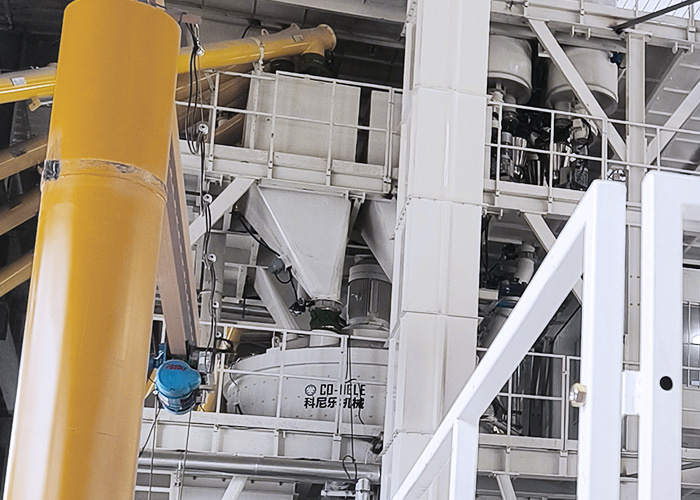
CO-NELE GRC mixer
Selecting a GRC mixer requires more than comparing motor power or mixing chamber capacity. Manufacturers should evaluate the actual material characteristics and production process.
For premix production, prioritize fiber feeding, dispersion uniformity, and controlled mixing intensity.
For spray-up production, prioritize slurry homogeneity, rheological stability, and continuous delivery.
Determine the required output according to:
- Daily or hourly production targets.
- Actual batch size.
- Mixing and discharge cycle.
- Number of operating shifts.
- Downstream casting or spraying capacity.
The mixer should be matched to the complete production line rather than selected solely by nominal chamber volume.
Ask the equipment manufacturer to conduct a trial using your actual GRC formulation.
Check:
Whether fiber bundles or agglomerations remain.
Whether fibers are distributed consistently.
Whether the mixing process causes excessive fiber shortening.
Whether the finished slurry meets the required flowability and workability.
A material trial is generally more meaningful than comparing motor power alone.
If production volume is expected to increase, consider PLC control, automatic batching, fiber feeding, and material transfer systems.
A properly configured mixing station can reduce manual intervention and improve production repeatability.
Q1: What is the best mixer for Glass Fiber Reinforced Concrete (GRC)?
A planetary concrete mixer is a suitable option for many GRC applications because its compound mixing motion promotes comprehensive material circulation and uniform mixing. It can be configured for both premix mortar and spray-up slurry preparation.
The final selection should depend on the GRC formulation, production process, and required output.
Q2: Can a planetary concrete mixer damage glass fibers?
Any mechanical mixing process can potentially affect fiber length if the mixing conditions are unsuitable. However, a properly configured planetary mixer with appropriate blade design, speed, and mixing time can help achieve effective fiber dispersion while controlling mechanical stress.
Trial mixing is recommended to verify fiber integrity.
Q3: What is the difference between a GRC premix mixer and a spray-up mixer?
The main difference is how the glass fibers are incorporated.
In premix production, chopped fibers are added directly into the mixer and dispersed throughout the mortar.
In spray-up production, the mixer prepares the cement slurry, while glass fibers are chopped and sprayed separately at the spray gun.
Therefore, premix equipment needs to accommodate controlled fiber incorporation, whereas spray-up equipment needs to provide stable, pumpable slurry.
Q4: What is the capacity range of CO-NELE GRC mixers?
CO-NELE planetary concrete mixers cover capacities from 50 L laboratory models to 6000 L industrial models, providing options for formulation testing, pilot production, and large-scale manufacturing.
Q5: Can one CO-NELE mixer be used for both GRC and UHPC?
Yes, a suitably configured planetary mixer can be used for different cement-based composite materials, including GRC and UHPC.
However, mixing blades, operating speed, mixing sequence, and other parameters may need to be adjusted according to each material's characteristics.
Q6: How can manufacturers determine the right GRC mixer capacity?
The selection should consider batch size, target production output, mixing time, discharge time, and downstream forming capacity. CO-NELE can recommend a suitable configuration based on the customer's production requirements and material formulation.
Consistent GRC quality begins with effective mixing. Uniform mortar preparation, controlled fiber incorporation, and stable material properties are essential for producing reliable glass fiber reinforced concrete components.
CO-NELE planetary concrete mixers offer a flexible mixing solution for both GRC premix and spray-up production. With capacities from 50 L to 6000 L, adjustable operating parameters, automated control options, and integrated fiber feeding solutions, CO-NELE can support GRC manufacturers from laboratory testing to industrial production.
Looking for a suitable GRC mixer for your production line?
Contact CO-NELE to discuss your material formulation, production process, and capacity requirements. Our team can help evaluate the appropriate planetary mixer configuration for your GRC manufacturing application.

Phone: 0086-15253277366
Hougu Town Village, Xiazhuang Street, Chengyang District, Qingdao
Copyright © CO-NELE 2019.
We will contact you within 24 hours.